
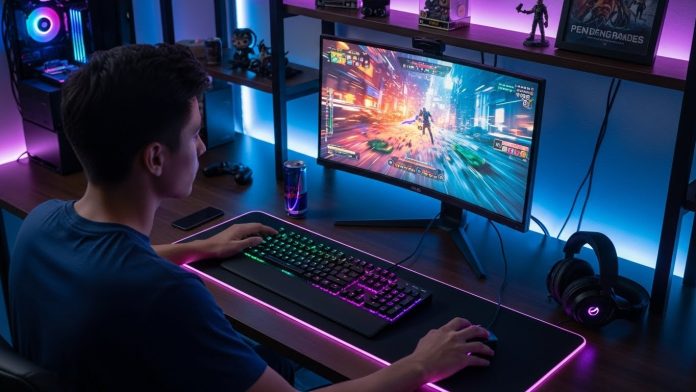
The living room is no longer the only place where play happens, and the console is no longer the whole story. Across the United States, gaming technology trends are changing how people relax after work, connect with friends, watch live events, and even spend time with family. More than 205 million Americans play video games, which means gaming is not a side hobby for a small group anymore; it is one of the country’s everyday entertainment habits.
That shift matters because players now expect more than better graphics. They want faster access, smarter worlds, flexible devices, cleaner online play, and experiences that fit into real life. A parent in Ohio may play a co-op game with a child after dinner. A college student in Texas may stream from a tablet between classes. A creator in California may build an audience around one game update. For broader digital entertainment coverage, resources like modern media and technology insights show how fast these habits keep moving.
Smarter Hardware Is Raising the Standard for Everyday Play
Better gaming used to mean buying the newest console, plugging it in, and waiting for the next big title. That idea feels too small now. Hardware still matters, but the best setup is no longer about raw power alone. It is about response time, comfort, display quality, storage speed, and how well each device fits the way you play.
American players are also more practical than brands often admit. A $2,000 gaming PC may excite one person, while another wants a quiet console that works from the couch without weekly tinkering. The real trend is not excess. It is smarter matching between device and lifestyle.
Faster chips are making performance feel more natural
Modern processors and graphics cards do more than push higher frame rates. They reduce the tiny delays that make a game feel heavy. When a racing game responds the instant you touch the trigger, the whole experience feels more alive. You stop thinking about the machine and start reacting to the road.
AI-assisted graphics are part of this shift. NVIDIA’s DLSS 4, for example, uses AI-driven frame generation and image reconstruction to raise performance while keeping visuals sharp. That matters for players who want ray tracing, smoother motion, and high-resolution displays without turning every setting down.
The unexpected part is that smarter performance can matter more than maximum performance. A stable 90 frames per second often feels better than a game jumping between 80 and 140. Players remember smoothness more than numbers on a settings screen.
Storage speed is changing how players judge quality
Fast loading has become a quiet deal-breaker. Older games trained players to tolerate long waits, but current consoles and PC drives have changed patience levels. When one game loads in seconds and another makes you stare at a spinning icon, the slower title feels older even if its art looks beautiful.
This matters most for open-world games. A player in Florida who has 40 minutes before work does not want to lose six of them to menus, loading screens, and updates. Quick resume features, SSD storage, and better patch handling have turned convenience into part of entertainment quality.
Developers now design around that speed. Dense cities, instant fast travel, and larger scenes work because storage can feed data faster. The funny thing is that players may never praise the drive inside the machine. They only notice when it fails them.
Gaming Technology Trends Are Making Play More Flexible
Entertainment has moved away from fixed schedules. People stream shows when they want, listen to music across devices, and expect games to follow the same pattern. That is why gaming technology trends now point toward access as much as horsepower.
The old question was, “What machine do you own?” The newer question is, “Where do you want to play right now?” That change is reshaping homes, dorm rooms, hotels, and even break rooms across the USA.
Cloud gaming platforms are turning screens into game doors
Cloud gaming platforms are built around a simple promise: the heavy work happens somewhere else. Your screen becomes the access point. That can be a smart TV, a laptop, a phone, or a handheld device with a steady connection.
The appeal is clear for players who do not want to buy expensive hardware every few years. A teenager in a small apartment can play demanding titles without owning a huge tower. A traveler can continue a campaign from a hotel room. A family can test games without filling a console drive.
The catch is also clear. Internet quality still decides the mood. A cloud game can look impressive, then fall apart when the connection stutters. That is why cloud gaming platforms will not replace local machines for every player soon, but they will keep pulling casual and budget-minded players into bigger game libraries.
Cross-device play is changing who gets included
Cross-play and cross-progression may sound like technical features, but they solve a human problem. Friends rarely own the same device. One has a PlayStation. Another has an Xbox. Someone else plays on PC because that is what they use for work.
When games remove those walls, social play gets easier. A group can stay together without forcing everyone into the same purchase. That matters in American households where one person may use the living room console while another plays from a laptop upstairs.
There is a business lesson hiding here. The winning game is not always the one with the prettiest trailer. Often, it is the one that makes it easiest for people to show up together. Convenience builds loyalty before graphics get a chance.
Immersion Is Moving Beyond Bigger Screens
Visual quality still sells games, but immersion has become more layered. Players want sound that places them in the room, controllers that react with texture, worlds that respond with logic, and characters that feel less like vending machines for dialogue.
Immersive gaming experiences are no longer limited to expensive VR setups. They show up in better headphones, adaptive triggers, spatial audio, haptic feedback, wider displays, and smarter game design. The best examples do not scream for attention. They pull the player in quietly.
Virtual reality is finding its real audience
VR has been hyped for years, sometimes beyond what the hardware could support. The better view is more grounded. VR works best when the game has a reason to put your body inside the action. Fitness games, racing cockpits, flight sims, rhythm games, and social spaces all make more sense than forcing every genre into a headset.
Market interest remains strong, with analysts pointing to growth in VR gaming as hardware improves and content libraries expand. Still, the American buyer is careful. Many players want lighter headsets, lower prices, less motion sickness, and games that feel complete rather than experimental.
That caution is healthy. VR does not need to replace flat-screen gaming to matter. It needs to own the moments where presence changes everything. Sitting inside a cockpit during a night race can do what a normal screen cannot.
Immersive gaming experiences depend on sound and touch
A great headset can change a game faster than a new display. Footsteps behind you, rain hitting metal, or a distant reload in a shooter all give the brain information before the eyes catch up. Good audio does not decorate the game. It teaches you how to survive inside it.
Controllers have become part of that language too. Adaptive triggers can make a bow feel tense or a brake pedal feel stiff. Haptic feedback can separate gravel from pavement without showing a single extra pixel. These small signals create trust between the player and the world.
The counterintuitive truth is that immersion often comes from restraint. A game that vibrates nonstop becomes noise. A game that saves feedback for the right moments feels intentional. Players can feel the difference even if they cannot explain it.
AI, Online Worlds, and Player Safety Are Redefining Value
The next wave of gaming is not only about prettier worlds. It is about worlds that behave better. AI systems, moderation tools, smarter matchmaking, and safer social spaces now shape whether people stay in a game after the first week.
This is where entertainment turns into responsibility. A game can have strong graphics and still lose players if cheating spreads, voice chat becomes toxic, or matchmaking wastes everyone’s evening. Technology has to protect the fun, not only display it.
AI in gaming is improving enemies, worlds, and workflows
AI in gaming can make non-player characters react with more believable timing. Enemies can flank instead of marching into danger. Sports opponents can adjust to repeated plays. Open-world characters can follow schedules that make a city feel less staged.
The development side may change even more. Studios can use AI tools to test large maps, catch bugs, support animation work, and help teams manage huge content demands. That does not remove human taste. It makes human direction more valuable because bad automation still produces flat results.
Players should expect a mixed period. Some games will use AI in gaming to create richer moments. Others will use it to cut corners. The difference will show fast. A smart enemy feels alive; a lazy generated quest feels like homework wearing a costume.
Safer online play is becoming part of the entertainment package
Online gaming lives or dies by trust. Players need fair matches, stable servers, useful reporting tools, and communities that do not punish people for speaking. This matters for kids, but it also matters for adults who are tired after work and do not want an argument with strangers.
Better moderation now includes voice analysis, text filters, behavior scoring, and faster review systems. None of it is perfect. Still, games that take safety seriously feel easier to return to, especially for families deciding what belongs in the house.
The best studios understand something simple: player safety is not separate from fun. It is the floor under it. When cheating, harassment, and spam are controlled, the game itself gets room to breathe.
Next Generation Consoles and Living Room Entertainment Are Blending Together
The console is no longer a box that only plays discs or downloads games. It sits at the center of streaming apps, voice chat, subscriptions, screenshots, live broadcasts, and family entertainment. That makes next generation consoles feel less like single-purpose machines and more like entertainment hubs.
This shift fits American homes well. Many families already gather around one main screen. The device under that screen needs to handle games, movies, sports apps, party chat, and quick switching without turning the evening into tech support.
Subscription libraries are changing how people discover games
Game subscriptions have trained players to browse differently. Instead of buying one title and hoping it delivers, many people now sample several games in a month. That can help smaller studios reach players who might never risk a full-price purchase.
The downside is attention pressure. When a library has hundreds of choices, a player may quit a good game after 15 minutes because another icon looks tempting. Discovery has become easier, but commitment has become harder.
Newzoo reported that the global games market reached an estimated $188.8 billion in 2025, showing how large and competitive the space has become. In that kind of market, next generation consoles need more than exclusive games. They need better ways to help people find what fits their mood tonight.
The living room setup is becoming more personal
A modern gaming room does not have to look like a neon showroom. Many players now care about comfort, clean cables, low-lag TVs, better seating, and audio that works for both solo play and family time. The best setup feels personal, not loud.
Parents may want privacy controls and shared accounts. Competitive players may want low input delay and a wired connection. Casual players may want a simple controller dock and a TV that switches game mode without digging through menus.
That practical side often gets ignored, but it shapes daily satisfaction. A console with strong specs can still frustrate people if the interface feels messy. A modest setup can feel premium when it removes friction from the evening.
Conclusion
The future of play will not be won by one device, one platform, or one flashy feature. It will be won by the systems that respect how people actually live. Americans are playing across busy schedules, mixed households, different budgets, and wider age groups than gaming culture used to admit.
That is why gaming technology trends matter beyond the hardware aisle. They point toward entertainment that is faster to start, easier to share, safer to enjoy, and more personal in every room. The smartest players will not chase every upgrade. They will choose the tools that make their favorite kind of play feel better.
Studios, hardware brands, and platform owners should take the same lesson. Better entertainment is not only about spectacle. It is about removing the small barriers that drain joy before the game begins. Choose your next upgrade by asking one honest question: will this make play feel more alive when you sit down tonight?
Frequently Asked Questions
What are the biggest gaming technology trends in the USA right now?
Cloud access, AI-assisted graphics, faster storage, cross-play, VR growth, and better online safety are leading the shift. American players want games that look strong, start fast, work across devices, and feel easier to enjoy with friends or family.
How do cloud gaming platforms improve entertainment at home?
Cloud gaming platforms let players stream games without relying on high-end local hardware. They work best for people who want flexible access across TVs, laptops, tablets, and phones, though a stable internet connection remains the biggest factor in quality.
Why is AI in gaming becoming more common?
AI in gaming helps create smarter enemies, faster testing, better animation support, and more responsive worlds. When used well, it makes games feel less scripted and more alive. When used poorly, it can make content feel generic or thin.
Are immersive gaming experiences only about virtual reality?
No. Immersive gaming experiences also come from spatial audio, haptic feedback, adaptive triggers, better lighting, wider displays, and responsive world design. VR is one part of immersion, but many players feel deeper presence through sound and touch.
Do next generation consoles still matter with cloud gaming growing?
Yes. Next generation consoles still offer strong local performance, stable play, family-friendly setup, and easy living room access. Cloud gaming adds flexibility, but consoles remain the better choice for players who want consistent quality without connection worries.
What gaming setup is best for casual American players?
A current console, low-lag TV, comfortable controller, solid internet, and good headset are enough for most casual players. The best setup is not the most expensive one. It is the one that starts quickly and fits your routine.
How is online safety changing modern multiplayer games?
Game companies are adding stronger reporting tools, better moderation, voice and text filtering, and anti-cheat systems. These tools help protect players from harassment, spam, and unfair matches, which makes online play more welcoming for families and adults.
Should players upgrade their gaming hardware every year?
Most players do not need yearly upgrades. Upgrade when your current setup causes clear problems, such as slow loading, poor frame rates, limited storage, or missing features you use often. A targeted upgrade usually beats buying new gear for hype.

